![]() |
| Source: XKCD.com |
July 17, 2026
XKCD 3144: Phase Changes
September 8, 2025
Where is he? We'll never know.
![]() |
| Source - Brewster Rockit |
See, it's funny because it's a reference to the Heisenberg Uncertainty Principle in which - in a very simplified format - we can know the momentum or position of a particle but never both.
I warn you, the uncertainty principle is a whole lot more complicated in its real form, but unless you're really into quantum mechanics, I recommend that you take the simple version instead.
With larger objects - say a person or a baseball - we can know the two quantities about the object almost perfectly, but as the object gets smaller - like atoms and protons and electrons or a shrunken Brewster Rockit - we can know less and less about the combination of the two quantities.
I get it. It takes some subtlety and understanding of the world of quantum mechanics to get the joke.
Luckily, I get the joke...like I got this other, similar one.
September 1, 2025
That's hydride.
![]() |
| Source - SMBC |
See, it's funny because...well, honestly I don't necessarily understand why it's funny in a scientific sense.
I get that - as is often the case in many genie stories - the genie fulfills the wish as spoken but not necessarily as the person intended it to be fulfilled. It's a fairly common trope, donchaknow.
But there are hydrogen atoms with two electrons or at least hydrogen ions that have two electrons. I guess changing every hydrogen atom to hydride ions (hydrogen with two electrons) would cause some problems, but I don't necessarily know that all of that would lead to immediate explosions.
May 20, 2024
Hell...and a miscommunication...
![]() |
| Source - Cyanide & Happiness |
See, it's funny because Joe doesn't seem to understand that warm gases expand, lowering their density and causing them to rise to higher levels. So I guess the first - assumedly top level from the diagram that the devil points at - would be the hottest level just like how the upper stories of a building are usually warmer than the lower stories.
Then again, the circles of hell as described by Dante Alighieri in his Inferno suggest that the lower levels are for the greater sinners where greater punishment is meted out, and that image seems to have permeated the popular consciousness, so Joe's thinking seems to be reasonable.
Maybe this is another example of two people both being correct but simply not communicating with each other.
Just talk it out, Devil and Joe.
Then again, if we assume that hell is somewhere underground - maybe under Turkmenistan, maybe somewhere else - then the geothermal gradient should likely be considered.
June 5, 2023
Hydrogen Isotopes
![]() |
| Source: https://xkcd.com/2719/ |
See, it's funny because hydrogen actually does have three isotopes with official names: protium (hydrogen-1), deuterium (hydrogen-2), and tritium (hydrogen-3).
If you're not ready to follow along, the empty circles with a + are protons. Each hydrogen by definition has to have one of those, so a couple of the isotopes up there aren't really hydrogen.
The filled, black circles are neutrons. Those can be different - which is what makes isotopes different in the real, non-xkcd world.
The smaller circles with a minus sign (-) are electrons. Most neutral hydrogens have one of those, too, because positives and negatives sort of need to balance each other out.
The rest of them in that diagram aren't real. Technically explainxkcd.com says ium and instant hydrogen technically exist but certainly aren't common. The oops, all neutrons is a reference it Cap'n Crunch's Oops, all berries cereal. I would reference a particular comedian's routine about the Oops, all berries cereal, but it's not school-appropriate.
His name is K. Trevor Wilson...in case you wanted to look it up...which you clearly shouldn't do because he uses words that aren't school-appropriate.
April 24, 2023
XKCD - hand dryers (2743)
![]() |
| Source - XKCD.com/2743/ |
See, it's funny because I've never thought about that being the reason hand dryers don't seem to put out hot air as quickly as it seems like they should.
It's the same idea as trying to brown a steak. If the outside of the steak is wet, the outside can't brown because the energy is going to evaporate the water which has to happen until all the water is gone, keeping the surface of the meat no hotter than 100 C. Once that water is gone, however, the steak's surface can get hotter and can brown.
Once your hands are dry, they can feel the warmth.
Until then, though, you just get evaporative cooling.
January 2, 2023
Solar System Model
![]() |
| Rollover joke - The Earth is, on average, located in the habitable zone, but at any given time it has a certain probability of being outside it, which is why life exists on Earth but is mortal. (Source - XKCD) |
See, it's funny because most of the time, the atom - particularly the Bohr model of the atom - is likened to the solar system with electrons following 'orbital' paths around the nucleus the way that planets follow similar paths around the sun.
As a chemistry teacher, I can say that it's much, much harder to come up with a similarly easily understood analogy for how electrons exist in the quantum mechanical model of the atom. There just isn't any sort of macroscopic thing that is anything like the quantum mechanical model of the atom.
And if the planets did move like electrons, that would be somewhat terrifying - especially as electrons can teleport from region to region a la an electron in a box.
Though I do have some evidence that the planets have a measurable spin, so there is that, at least.
September 12, 2022
XKCD: Coffee Cup Holes
![]() |
| Source - https://xkcd.com/2658/ Rollover text: Theoretical physicist: At the Planck length, uncountably many. |
See, it's funny because...
I'll leave the middle three panels (and the rollover text) to the fine crowdsourcing folks at explainxkcd. If you don't get those, check the link.
...but the chemistry one is all mine.
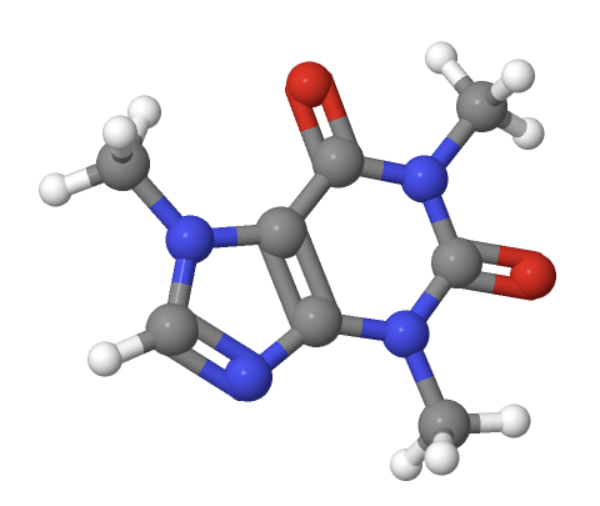
The caffeine molecule...
...is C8H10O2N4 (the grey spheres are C, white are H, red are O, and blue and N).
August 15, 2022
Chemicals
![]() |
| Source - https://xkcd.com/2648/ |
See, it's funny because just knowing which atoms - and even how many of each of those atoms - constitute a molecule doesn't mean that you can synthesize that molecule.
There's an analogy here to cooking. If I list the ingredients - even if I include the amounts of each ingredient - for a recipe, that doesn't give you enough information actually to make that final product. Listing the ingredients for a chocolate cake, for example, doesn't tell you in which order the ingredients should be assembled, nor does it tell you how to handle each of those ingredients. Do you whip the butter, fold it in, melt it, freeze it, crumble it into the flour?
That analogy, though, even undersells the complexity of molecules, however, because not all atoms will assemble in the ways we want them to assemble. Some molecules require very specific pathways to produce.
To read this explanation in far more words, check out explainxkcd.com.
July 25, 2022
Periodic Table Changes
![]() |
| Source - XKCD |
See, it's funny because the periodic table isn't the shape it is because of any sort of design sense. There are all sorts of details that would look or seem better if they were changed, but they can't be changed because they're based on properties, electron configurations, and property similarities - not on what would look neat.
See, the periodic table is appropriately periodic meaning there's a repeating pattern in its layout. In this case there's a repeating pattern in the properties of the elements when the elements are placed in order by their atomic number. Lithium is similar to sodium which is similar to potassium and on down with rubidium, cesium, and francium. With those similarities noticed, the elements were placed in columns with a new row (or period) starting every time those properties repeated.
It would be nice to see helium moved above beryllium, and there are some reasons why it maybe should be moved over there, but there are way more reasons why it belongs in column 18 with the noble gases.
Admittedly, changing the element symbols (iron = Fe but maybe should be I...silver = Ag but maybe should be Sv, and so on) is within the powers of a bunch of chemists if they really wanted to do it, but just moving the inner transition metals so they don't look dorky down at the bottom of the table isn't within the powers of those same chemists because it would require those elements to have different properties and different electron configurations. Those aren't things chemists have the power to change.
Maybe next week I'll rant about all the non-periodic periodic tables that I get shown in the course of my job.
July 4, 2022
Increasing intensity of chemical gradiant
See, it's funny because when you're following a smell, you're going from an area of low concentration of some chemical that your nose can register to an area of higher concentration. You're following a chemical gradient in the direction of increasing intensity.
Thanks, SMBC.
January 31, 2022
Blockbuster
| Source - Three Panel Soul |
See, it's funny because there was a movie called The Emoji Movie that was roundly and thoroughly panned by critics and still ended up being profitable.
So, if studios can build a movie around 'something kind of abstract and pretend it's a neoliberal bureaucracy,' and make money from it, it makes as much sense to make a Molecules movie as it does an Emoji Movie.
I am bothered, however, at the monatomic molecules, a clear oxymoron.
I do appreciate that Ian and Matt included the, 'one atom wants to get radical' joke...because radicals are atoms or molecules with an unpaired electron, making them highly reactive. The joke is nerdly funny.
December 18, 2021
The Last Molecule
| Source - https://xkcd.com/2552/ |
See it's funny because there's no way that chemistry - or any science, really - will ever be 'complete'.
I'll quote here from the explainxkcd.com entry because it's really well written (as is usually the case)...
"[T]this may be a reference to a quote from around 1900, often attributed to Lord Kelvin or Albert Michelson: "There is nothing new to be discovered in physics now. All that remains is more and more precise measurement."
...
"In real life the number of ways to arrange atoms into molecules grows combinatorically with the number of atoms in a molecule. Since molecules can be extremely large (up until the point where gravity takes over and initiates nuclear fusion), the number of possible combinations is much much larger than the number of particles in the observable universe, making the full cataloging of all molecules impossible. Thus, a "final molecule" cannot be reached. In addition, chemistry is the study of the interaction and changing states of atoms and molecules, not simply the cataloging of all specimens of molecule. Even if we did have a list of every molecule, there are a far greater number of ways to continue studying them, so the field would still be nowhere near completed."
...
"As readers are aware of this, part of the humor comes from the very high percentages given to the different fields. [...] Another part of the humor is the precision."
Jokes for nerds, folks, jokes for nerds!
May 4, 2020
SMBC: PuCube
![]() |
| Source - SMBC |
Working downward from the top...
- The plutonium would give off energy for way more than just "2+ generations", and it would heat the tea around it. From Randall's calculations, though, it seems like it would keep the tea warm but not hot.
- Plutonium in water would emit Chernekov radiation which glows a very pleasing blue.
- 1.5 cubic centimeters of plutonium would certainly fit in your pocket. It would be about 1.14 cm on each side of the cube.
- The plutonium would certainly sterilize your tea for you...if that's a problem you normally have with your tea.
- You likely would get to meet your local FBI agent - possibly an IAEA agent.
- You should not swallow PuCube. To get an idea of what could happen, read about this former Soviet spy poisoned via polonium.
- As to the $400,000 cost, the only reliable sources I could find put the price of plutonium between $4000 and $6000 per gram (though I prefer this answer). 1.5 cubic centimeters at 19.84 grams per cubic centimeter at $5000 (an average) per gram, that would be closer to $150,000. My math doesn't jibe with Zach's. I'd need to see his sources.
- PuCube certainly would be heavier than you would expect. 1.5 cubic centimeters of water (a fairly dense material) would have a mass of 1.5 g (at 4 degrees Celsius, natch). Osmium and iridium would be the most dense (at 22.6 and 22.4 g/mL respectively - source), but I'm guessing the plutonium would be much heavier than you would expect. I've picked up mercury (13.546 g/mL compared to plutonium's 19.84 g/ml), and it was surprisingly heavy.
- The repeated warning not to swallow PuCube make me think of Happy Fun Ball. Do not taunt PuCube.
October 22, 2019
2019 Nobel - lithium-ion batteries
![]() |
| Source: XKCD |
That's not really what the 2019 Nobel prize in chemistry went to, but it would be funny if it had.
Instead, the 2019 Nobel prize went to a trio of scientists who developed the technology for lithium-ion batteries.
September 24, 2018
XKCD - disaster movie
![]() |
| Source - link |
Instead, scientists would be more likely to be looking to update their data about the world as the disaster happens. In fact, as explainxkcd explains (natch)...
The situation described (scrambling to update geographical datasets in the advent of natural disaster) is actually a common occurrence these days. The Humanitarian OpenStreetMap Team's Disaster Response unit does almost exactly this: When there is a natural disaster in a location that lacks high quality GIS data (common in much of the developing world), a team of volunteers across the world mobilises to update and improve OpenStreetMap. They use the latest available satellite imagery, usually donated free for the purpose. Disaster response teams then use the GIS data in OpenStreetMap to create maps and plan their response.
March 2, 2018
Purity
See, it's funny because scientists are known to reduce other branches of science to being just an applied version of their own. Chemists claim than biology is just applied chemistry, then physicists claim that chemistry is just applied physics and so on.
Then comes mathematics on which all of the sciences are based and which isn't necessarily - at least as far as this comic is concerned - based on any of the other STEM fields.
Plus it has a squirmy, stick-figure-style octopus and a psychologist with a stick-figure, folkster beard. That's inherently funny.
February 26, 2018
Bond..._____ Bond
See, it's funny because...well...if you don't know the phrase, check out this video.
Hydrogen bonds form between two molecules that have high electronegativity differences between hydrogen and another nonmetal (typically F, N, or O). Hydrogen and the highly electronegative element can get very close to each other due to hydrogen's small atomic radius, so the molecules attract very strongly.
That makes this joke especially ironic because James Bond almost never got emotionally close to any of his co-stars...except Teresa Draco, of course.
The joke has also been made about ionic and covalent bonds...because it's an easy joke to make...
February 21, 2018
The melting point of gallium is...
See, it's funny because gallium melts at - as the comic caption says - 85.58 degrees Fahrenheit. Body temperature is 98.6 degrees Fahrenheit, so the metal dog would likely melt over night meaning that dad wouldn't have to buy his boy a puppy but will be able to say that it's his boy's fault.
I am thinking, however, that this might be a bad idea, not really because of the toxicity (a pretty minor risk for gallium) but rather because of the challenge of explaining that the gallium didn't technically 'wet' the bed because its intermolecular forces are strong enough to hold mostly together and didn't attract to the bed sheets.
February 13, 2018
"Glassblowing kits, which taught a skill still important in today’s chemistry labs, came with a blowtorch."
See, it's funny because chemistry sets used to be a thing. In the early 1900's chemistry sets were sold, hoping to promote scientific exploration among young (admittedly pretty much just) boys.
From a Smithsonian article...
The safety-conscious 1960s brought a quick end to the chemistry set’s popularity. The Federal Hazardous Substances Labeling Act of 1960 required labels for toxic and dangerous substances, and chemistry set makers removed the alcohol lamps and acids from their kits. The Toy Safety Act of 1969 removed lead paint from toys but also took its toll on the sets. The creation of the Consumer Product Safety Commission in 1972 and the passing of the Toxic Substances Control Act in 1976 resulted in further limits on the contents of the kits. Newspapers that once broadcast the arrival of new kinds of chemistry sets soon warned of their dangers, recommending that they only be given to older children and kept locked up from their younger siblings. “The death of the chemistry set is almost an unintended consequence of the rise in consumer protection laws,” says Cook.Sadly, it looks like in the world of the webcomic, all chemicals possibly more dangerous than water have been removed from chemistry sets.
More readings about the decline of the chemistry set
- from Philosophy of Science
- from the BBC
- from Wikipedia