
July 31, 2015
How to reveal subatomic particles at home | NOVA
Holy crap that's awesome.
Dry ice is a little tough to scrounge up in those chunks. Meijer and Graeters both sell dry ice. I know Meijer sells theirs in blocks about six or eight inches on a side and maybe two inches thick. I'm not sure in what shape Graeters sells theirs.
I also know that - in Cincinnati - Continental Carbonics sells pellets with (from the last time I was there in maybe 2012 or 2013) a ten pound minimum.

July 27, 2015
The name of the blog
In case you were curious as to where the title of the blog comes from, check the above video at 0:19.
Semisonic also put out an interesting poster of glassware along with that album.

The Rio Celeste - not a reaction

Atlas Obscura says it ever so simply and vaguely...
The river gets its coloration from a mixture of sulfur and calcium carbonate which are seeded into the water from the nearby volcano.So does Neatorama...
large quantities of sulfur and calcium carbonate, which gives the river a beautiful blue tint...and The Soul is Bone...
a vivid blue colour, the result of the chemical reaction( the result of sulphur and calcium carbonate mixing) generated by a mixture of minerals present in the volcanic massifOf course, that chemical reaction isn't very well explained there, so I went a looking for some more detail. Here's what I found on Wikipedia...
The source of the river's distinctive turquoise color is not a due to a chemical species but to a physical phenomenon known as Mie scattering.[3] Celeste River is fed by two colorless rivers, the Buenavista River and Sour Creek. Buenavista River carries a large concentration of aluminosilicate particles with a small diameter. Sour Creek, as its name implies, has a high acidity due to volcanic activity. When these two streams mix to form Celeste River, the drop in pH causes the aluminosilicate particles to aggregate and enlarge to a diameter of about 566 nm. These suspended particles produce Mie scattering which gives the river a strong turquoise color.I clicked through citation #3 and found an article on PLOS One, the Public Library of Science, that has a heck of a lot more math and SEM images than I wanted to read through.
No matter what those data said, it's still a good reminder that it's a good choice to dig a little deeper when the explanation seems a bit too simple.
Otherwise, you may find yourself in murky waters.
Pretty, but murky waters...

Carbon Engineering - industrial-scale capture of CO2 from ambient air
I'm really, really curious to know the specific chemistry of the carbon dioxide sequestration at 2:55. I guess it could be a solution of calcium oxide (that would react with the carbon dioxide to make calcium carbonate, though I don't think calcium oxide is highly soluble), I guess.
Yes, we need to get the carbon dioxide out of the atmosphere, but there has to be a lot of energy input to get the solution made, the metals refined, the fans churning, and the polymer liner made. We're going to have to take a whole lot of carbon dioixde out of the atmosphere to balance all that out.
Fake Science

Fake Science - the name says it all right there, doesn't it? Fake science.
As in not real science...like science that is funny and chucklesome but not true at all.
See, there is no wool in sheep blood, even if the blood gets transmitted to humans via mosquitos.
And the number of tree rings doesn't really line up with the how many trees the tree slept with...

...nothing is really better than ice cream...

...thought I will say that chemists do need a bunch of atoms. That's not hype!

WebElements

A chemist - or a chemistry student - needs a good periodic table.
In fact, it's my belief that a good chemistry teacher, in fact, needs a whole bunch of periodic tables.
My favorite site for periodic table data is WebElements from the University of Sheffield out of the UK. Every element has a number of pages of data - elemental, radioisotope, historical, and much more data on every one.
Plus they have a bunch of cool stuff for sale on their store (I already have the Chinese periodic table but would love the periodic table magnets, the orbital poster, a door poster of periodic tables,
Compound Interest

I have a great appreciation for good design, particularly for good design with a purpose. Compound Interest is such a site, full of chemistry infographics with a pretty design sense, all produced by a British chemistry teacher (or instructor or lecturer or dustbin - whatever the British call chemistry teachers over there).
At the top of this post, we get a timeline of the element discoveries with flags so you can see where the element were discovered.
There's also this post of colours (again, British natch) that are visible during metal ion flame tests...
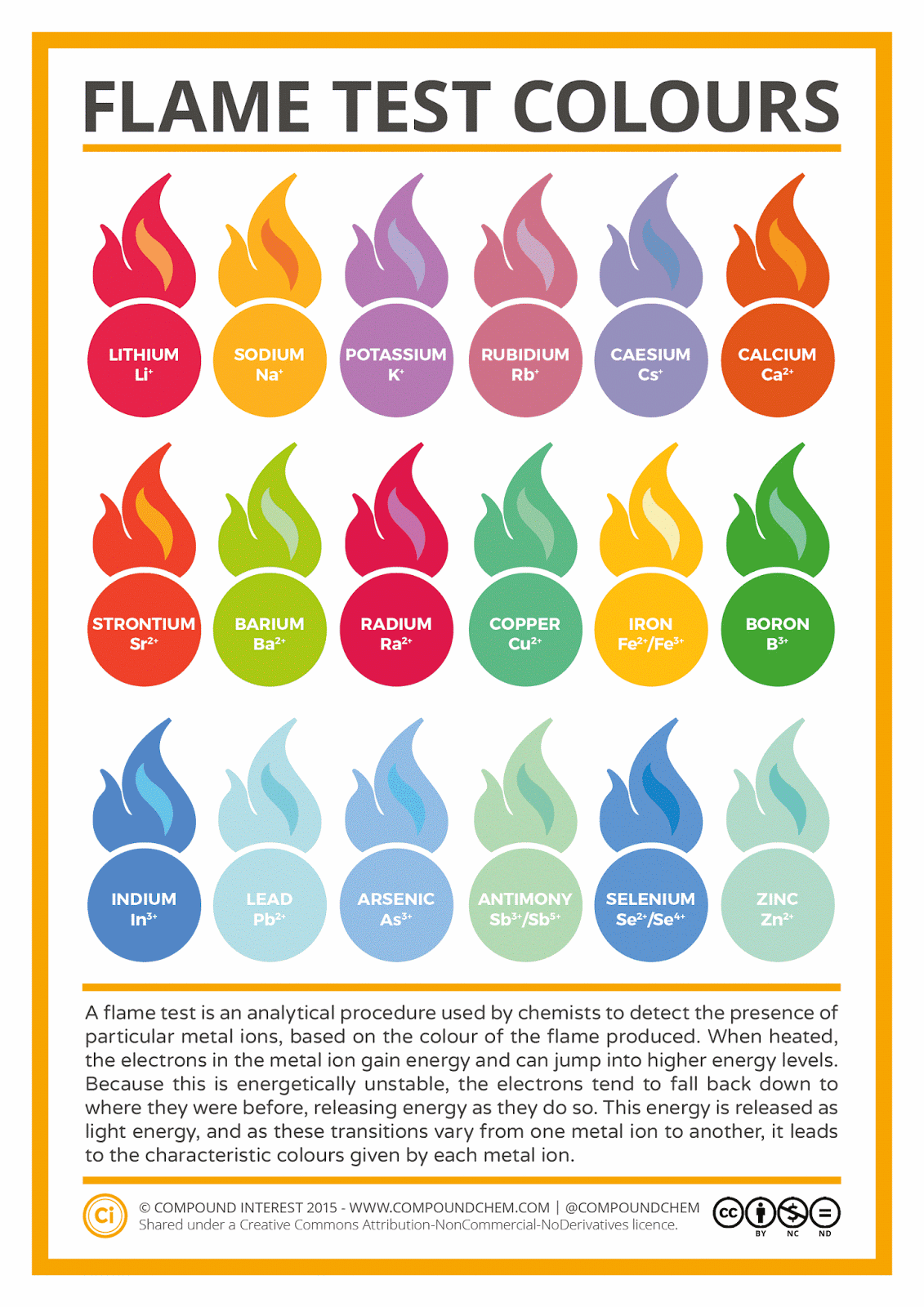

...and a hundred other infographics. Supposedly there's going to be a book coming in the fall, but it hasn't gotten to the pre-order stage just yet.
Subscribe to:
Posts (Atom)